For industrial organizations, the challenge is not simply choosing between single sourcing and a larger supplier base. Single-source arrangements can reduce operational complexity, but they also concentrate risk: when a qualified supplier can no longer deliver, restoring supply may require new qualification, documentation, quality alignment, commercial agreements, and production validation. Expanding the supplier base can reduce this dependency, but it creates another cost – maintaining more supplier relationships through compliance, audits, performance follow-up, qualification, and ongoing administration.
Rapid manufacturing technologies are beginning to change this trade-off in two important ways. For internally designed parts without external IP restrictions, they create greater flexibility to access qualified manufacturing capacity when and where it is needed. For OEM-designed parts, the same technologies are enabling new commercial models, such as parts-as-a-service and subscription-based access, where OEMs can retain control of their IP while providing customers with more responsive access to critical parts. Together, these models create new opportunities to strengthen supply chain resilience without simply expanding the number of traditional supplier relationships.
The strategic question therefore becomes less about how many suppliers an organization has and more about how much qualified manufacturing capability it can reliably access. Real resilience comes from making that capacity operationally accessible with qualification, documentation, traceability, sourcing, and delivery managed within a structured framework. This shift from supplier ownership to capability access creates the foundation for a different supply model.
Fieldnode One: One Connection to a Broader Supply Network
Fieldnode is designed around this principle.
Rather than requiring an end user to establish and maintain separate relationships with every manufacturer it may need, Fieldnode provides a structured route into the wider ecosystem.
The underlying network connects asset owners, IP owners, engineering firms, manufacturers, and service providers. Digital workflows support the process from part identification and qualification through delivery fulfillment and validation records, including the design of parts to address specific operational issues and challenges. Supplier qualification, documentation, and traceability help establish a consistent operational framework.
The difference is important.
An organization does not need to build an increasingly large collection of individual supplier relationships simply to increase its available manufacturing options. Instead, it can access the capabilities of an entire network while retaining full control over supplier selection and choosing the most suitable supplier for each requirement.
In practical terms, the sourcing model begins to move from:
One supplier → one relationship → one capability
toward:
One connection → one workflow → access to a broader network of qualified capabilities.
This reflects the same operating principle behind Fieldnode Digital Supply: transforming isolated on-demand delivery cases into a scalable, trusted supply chain.
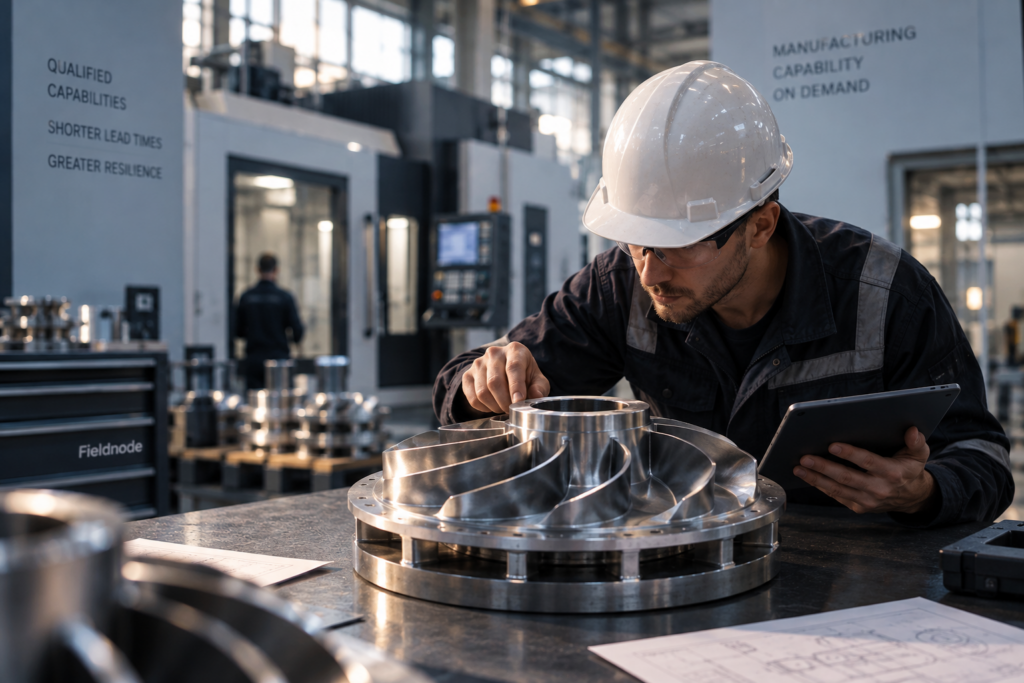
Resilience Without an Ever-Growing Supplier Base
This does not make existing supplier relationships less important.
In many cases, an established supplier will remain the best production route. The purpose of a network-based model is not to replace that relationship, but to reduce the operational barrier to accessing an alternative when circumstances change. Importantly, network-based sourcing can provide this flexibility without compromising control over technical requirements, specifications, quality, or qualification standards.
That leads to a different way of thinking about redundancy. Traditional sourcing creates redundancy by adding suppliers. Network-based sourcing creates redundancy by expanding access to qualified manufacturing capability — without requiring every potential production route to become another independently managed relationship.
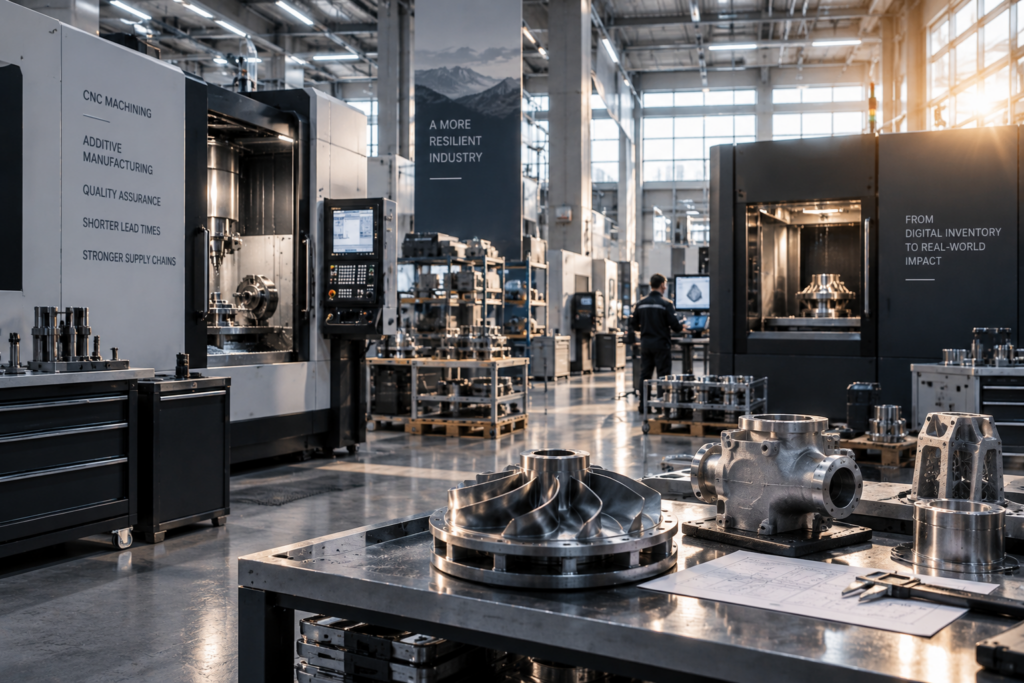
For procurement teams, this can mean a shift from continuously expanding the supplier base toward building reliable access to a qualified supply ecosystem, while maintaining the requirements, flexibility and controls needed for industrial operations. With the right digital support, faster request-to-quote cycles and shorter lead times become part of the standard sourcing process. Organizations can respond to operational challenges with minimal manual effort while retaining the flexibility to source from the most suitable supplier across the network, without the lock-in often created by traditional distributor setups.
A Better Question for Procurement
The strategic question is simple: how can we ensure a trusted and reliable route for sourcing the parts needed to keep our assets operating — regardless of their age or condition?
The answer lies in creating reliable access to qualified sourcing capability without adding unnecessary operational complexity.
One connection. One workflow. A scalable network of on-demand supply capability.