This summer four students joined Fieldnode through our collaboration with Sopra Steria Norge as part of Fieldnode NextGen 2026.
Rather than following a traditional internship program, they became part of ongoing product development, contributing to two different engineering projects that addressed real business and product challenges.
Although each team focused on a different objective, they shared the same experience: working with real data, real products, and real engineering decisions.
Project One: Building Smarter Engineering Connections with Intelligent Features
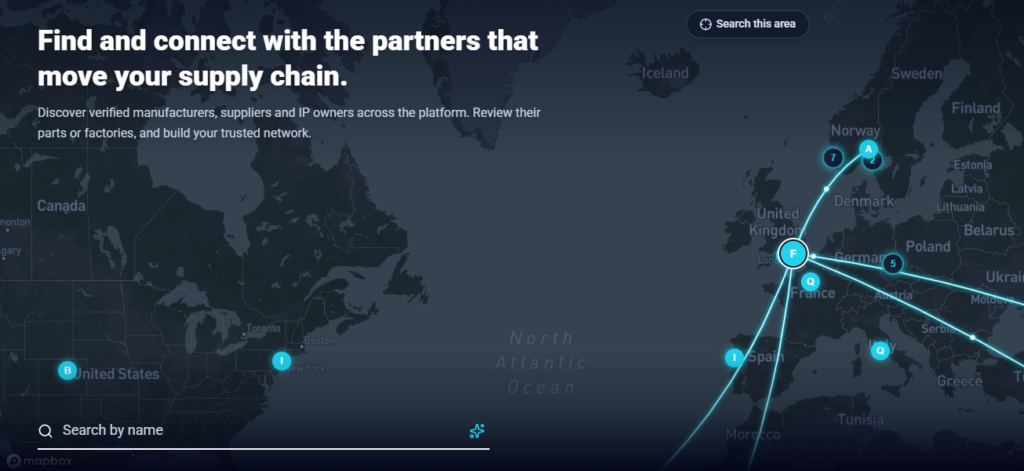
One of the teams worked on capabilities that support the continued expansion of the Fieldnode ecosystem beyond manufacturing.
As the network grows, industrial organizations need more than access to production capacity. They also need access to engineering expertise, trusted collaboration, and the right competencies throughout the product lifecycle.
Through their work, the students contributed to features that will help connect these capabilities, making engineering expertise an integral part of the broader industrial ecosystem.
Student Perspective
“My internship at Fieldnode has been a great experience. One of the biggest challenges at the beginning was understanding the domain and the many different aspects of the Fieldnode platform. There was a lot to learn, but every question was welcomed, which made it much easier to grow and become confident in the work.
Another new experience for me was collaborating with people from different countries and professional backgrounds. Working in such an international environment taught me how valuable different perspectives can be when solving engineering challenges, and it is something I will definitely take with me in my future career.”
Ole Jacob Mellgren
“My summer internship was a really valuable and enjoyable experience. It was especially cool to work on the networking page for Fieldnode’s Digital Inventory Platform and know that I was creating something that would actually be used by the company. I also really appreciated how helpful and welcoming everyone was. It made it easy to ask questions, learn from others, and feel involved in the work we were doing. Overall, I enjoyed seeing how the things I worked on contributed to a real product.“
Lara Jacobsen
Beyond the technical work, the project gave students first-hand experience of collaborating in an international engineering environment while contributing to capabilities that will continue to evolve as the Fieldnode ecosystem grows.
Project Two: Scaling Engineering Decisions Across Large Spare Parts Catalogues
The second team worked on a challenge that many industrial organizations face when transitioning toward more flexible supply chains.
Large spare parts catalogues often contain thousands of components. Determining which parts are suitable for on-demand production is not simply a matter of technical feasibility – it also requires evaluating manufacturing complexity, business value, and practical production constraints.
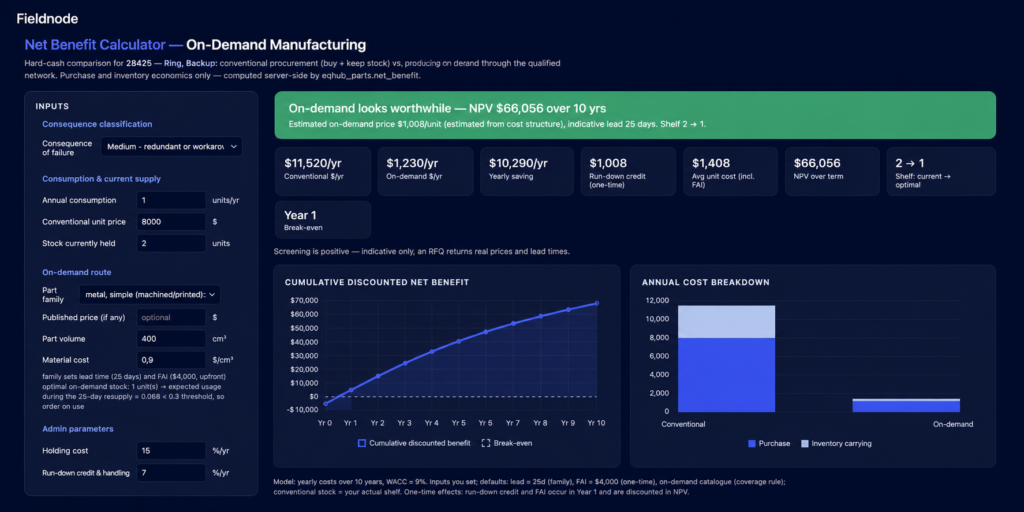
Manual assessment at this scale is unrealistic. The project therefore focused on developing a workflow capable of processing large volumes of spare parts data, identifying components with on-demand potential, estimating their business value, and supporting the RFQ process.
More importantly, the project highlighted that engineering decisions cannot rely on data alone. Capturing and scaling engineering expertise remains one of the biggest challenges in digital product development.
Student Perspective
“Working on a digital inventory and industrial data project at Fieldnode gave me a genuine look and new perspective on building a real data product, from cleaning complex datasets and developing classification models to exploring business cases for on-demand manufacturing.
The biggest surprise was how much nuance goes into decisions that sound simple at first, like interpreting accuracy while taking into account input from engineers. More than anything, it has left me wanting to keep working on problems where data, engineering, and business all have to meet in the middle.”
Frida Stiansen
“Over our internship at Fieldnode, we built an end-to-end workflow: processing a raw spare parts catalogue, classifying roughly 175,000 parts for on-demand production potential, and building a platform that estimates the business value of producing a part on demand and allows users to raise an RFQ directly from the results.
The biggest surprise was how much of it was judgement, not data. Real catalogues are messy and incomplete, and the line between a part that is technically manufacturable and one that is practical and economically viable for on-demand production is often unclear. Capturing one engineer’s expertise and applying it consistently across 175,000 parts is a challenge we’d happily spend years solving.”
Oleksandr Belei
The project demonstrated that scalable industrial solutions depend not only on technology, but also on capturing engineering knowledge and turning it into repeatable decision-making that can support large fleets of industrial assets.
Project Supervisor’s Reflection
One of the most rewarding aspects of this year’s Fieldnode NextGen programme was seeing how quickly the students took ownership of real engineering challenges. Rather than jumping straight into implementation, they invested time in understanding the problem, asking thoughtful questions, and navigating the ambiguity that comes with real industrial data and requirements.
Both teams were given problem statements rather than detailed specifications, allowing them to define features, explore solutions, and make their own technical decisions within our platform. They also brought fresh perspectives and ideas that continue to influence the team today.
Most importantly, they experienced that engineering is rarely about finding the perfect solution on the first attempt. Sometimes learning what doesn’t work is just as valuable, because it helps build better products in the long run.
Luka Grujic, Full-Stack Developer
Looking Ahead
Fieldnode NextGen was created to give future engineers the opportunity to work on challenges that matter – not hypothetical assignments, but projects connected to real products, real customers, and real industrial needs.
For the students, the programme provided valuable hands-on experience. For Fieldnode, it brought fresh perspectives, curiosity, and new ideas that contribute to the continued development of our products and ecosystem.
As the programme continues, we look forward to seeing how these experiences help shape the next generation of engineers – and how their contributions continue to strengthen the future of industrial collaboration.